
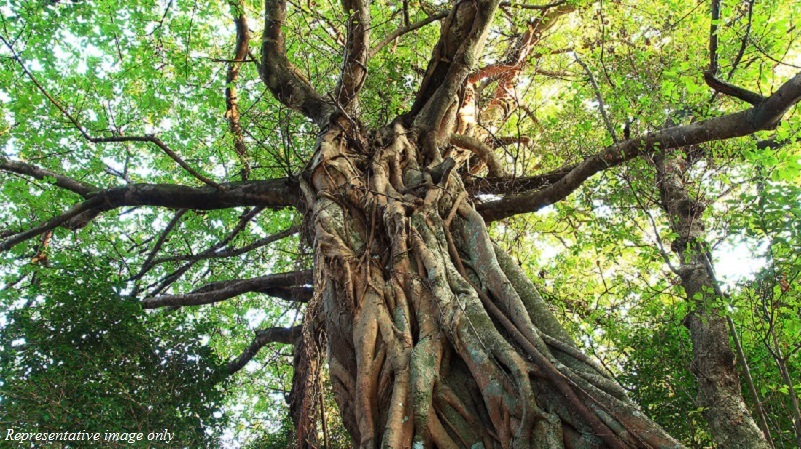
JAKARTA (Indonesia): In the remote landscapes of West Kalimantan province of Indonesia, the Iban Indigenous community has long maintained a practice that protects large strangler fig trees and the surrounding forest, even within areas cleared for agriculture. Central to this practice is the belief that strangler figs are inhabited by powerful spirits. Villagers consider it taboo to cut down these trees or disturb the land immediately around them. This cultural norm, known locally as “dipulau”, requires farmers to leave islands of vegetation, often extending about 10 meters from the tree canopy, when clearing land for crops. These vegetative islands act as refuges for wildlife and maintain ecological connectivity in heavily modified landscapes.
Strangler figs are considered keystone species in tropical forest ecosystems. Their fruits are available year-round, attracting a wide variety of animals, including birds, bats, primates and other mammals. By supporting these species, strangler figs contribute to seed dispersal, forest regeneration and overall biodiversity. In West Kalimantan, field surveys have shown that the density of strangler figs in farmland mosaics is comparable to that in old-growth forest. This indicates that even small patches preserved around sacred trees can sustain important ecological functions and serve as stepping stones for wildlife across human-dominated landscapes.
The practice of leaving fig trees untouched is reinforced by social and spiritual pressures. Community members report that those who harm sacred trees are believed to experience illness, misfortune or other negative consequences, strengthening compliance with the taboo. While Roman Catholicism is widely practiced in the region, these traditional beliefs coexist with formal religious practices, demonstrating the flexibility of local culture in maintaining ecological stewardship. However, researchers note that younger community members and individuals who marry outside the community are increasingly less likely to adhere strictly to the taboo. This change suggests that cultural erosion could impact the continued effectiveness of such informal conservation measures in the future.
Beyond individual tree protection, the Iban manage large tracts of customary forest, employing a combination of shifting cultivation, controlled harvesting and sacred-site preservation. This approach balances agricultural productivity with the maintenance of ecological integrity. The patches around strangler figs, although small relative to the total farmland, provide essential ecosystem services, including soil stabilization, water regulation, and microhabitat maintenance for insects, reptiles and understory plants. These services, in turn, support crop productivity by sustaining pollinators and natural pest predators.
The significance of these spiritual taboos extends beyond local forest management. Researchers suggest that recognizing and supporting such Indigenous knowledge systems could inform broader conservation strategies in tropical regions. In areas facing increasing deforestation and agricultural expansion, culturally embedded practices like the “dipulau” taboo demonstrate that non-regulatory, community-driven methods can effectively preserve biodiversity and forest structure. By maintaining both ecological and cultural continuity, the Iban community illustrates a model of conservation rooted in local knowledge, belief systems and social norms.
While challenges exist, including generational shifts and external pressures on land, the preservation of strangler figs in Sungai Utik provides a rare example of how spiritual belief and environmental stewardship intersect. These practices highlight the potential of Indigenous culture to contribute meaningfully to sustainable forest management and biodiversity conservation in Indonesian Borneo and similar tropical landscapes worldwide.
Click here to follow our WhatsApp channel and get instant updates