KOLKATA (West Bengal, India): In a significant development towards strengthening tribal education, the National Education Society for Tribal Students (NESTS), which functions under India’s Ministry of Tribal Affairs, has signed a Memorandum of Understanding (MoU) with the Government of West Bengal for effective implementation and monitoring of the Eklavya Model Residential Schools (EMRS) scheme in the state.
The MoU was signed here on Wednesday by Choten Dhendup Lama, Principal Secretary, Tribal Development Department, Government of West Bengal, and Dr. Pratima, Commissioner, NESTS, in the presence of Ranjana Chopra, Secretary in the Ministry of Tribal Affairs, Government of India.
Under the agreement, the funding for students under the EMRS scheme will increase substantially from Rs. 61,500 to Rs. 1,47,000 lakh per student. The state government will also undertake measures for making the sanctioned EMRS schools operational and complete the infrastructure of schools. Faculty recruitment will be made through a centralized process.
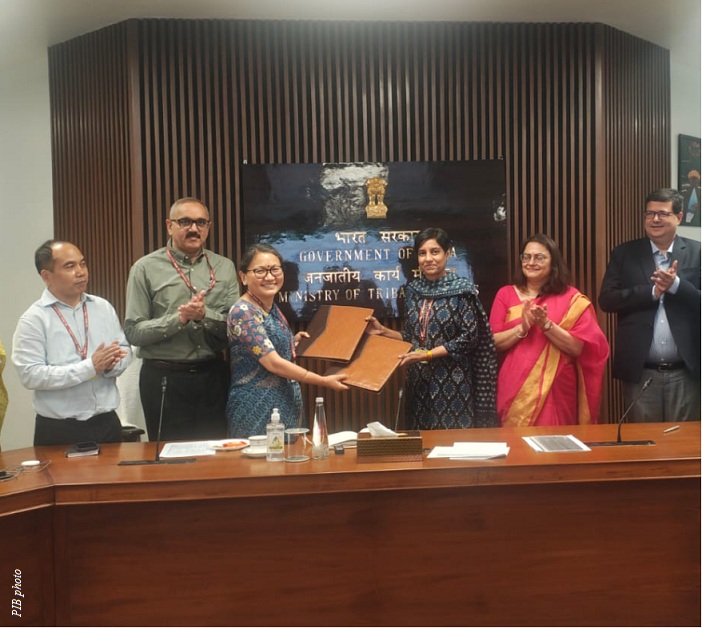
The MoU aims to strengthen institutional coordination for planning, construction, establishment and administration of EMRSs in West Bengal. It also seeks to ensure quality modern education for holistic development of tribal students through adoption of a common core curriculum based on NCERT guidelines and aligned with CBSE norms and standards, according to an official press release here.
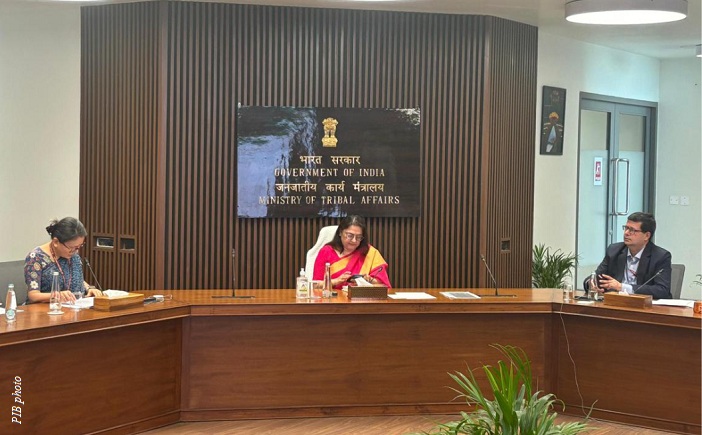
Earlier, Chopra presided over a meeting to review the implementation of different schemes and programs of the Ministry of Tribal Affairs in West Bengal. Discussions were held on the future course of action, strengthening inter-departmental coordination, improving fund utilization and expediting the coverage of pending interventions in tribal and particularly vulnerable tribal group (PVTG) areas.
The meeting specifically discussed the implementation of the two flagship schemes of the ministry in the state – the Pradhan Mantri Janjati Adivasi Nyaya Maha Abhiyan (PM JANMAN), and Dharti Aaba Janjatiya Gram Utkarsh Abhiyan (DA-JGUA). Chopra emphasized that the ministry and the state government must work together to ensure that the benefits of these campaigns reached tribal communities and PVTGs effectively.
Chopra said a guidance session on the Adi Karmayogi Abhiyan (AKA) would be conducted soon for officials of the state government for effective implementation. The state should expedite the notification of Adi Sewa Kendras (ASKs) in villages covered under DA-JGUA and PM JANMAN, with efforts to deploy teams of 5 to 7 volunteers in each ASK through strong community participation mechanisms, she also said.
Lama told the meeting that various departments of the state government were in the process of formulating and submitting proposals to the ministries concerned under the campaigns. The PVTG household survey in the state had commenced on Wednesday and would be completed in time, she said.
The other key issues discussed during the meeting were submission of proposals and utilization certificates, progress of sanctioned projects under various schemes, implementation of the Forest Rights Act (FRA), making Van Dhan Vikas Kendras (VDVKs) operational, strengthening of Tribal Research Institute (TRI), and participation in innovative projects focusing on skiling and livelihood generation for tribal communities.
Also present at the meeting were senior officials from the Ministry and affiliated organizations, including Manish Thakur, Additional Secretary, Brij Nandan Prasad, Joint Secretary, T. Roumuan Paite, Chairman-cum-Managing Director, National Scheduled Tribes Finance and Development Corporation (NSTFDC), and Anant Prakash Pandey, Joint Secretary.
Click here to follow our WhatsApp channel and get instant updates