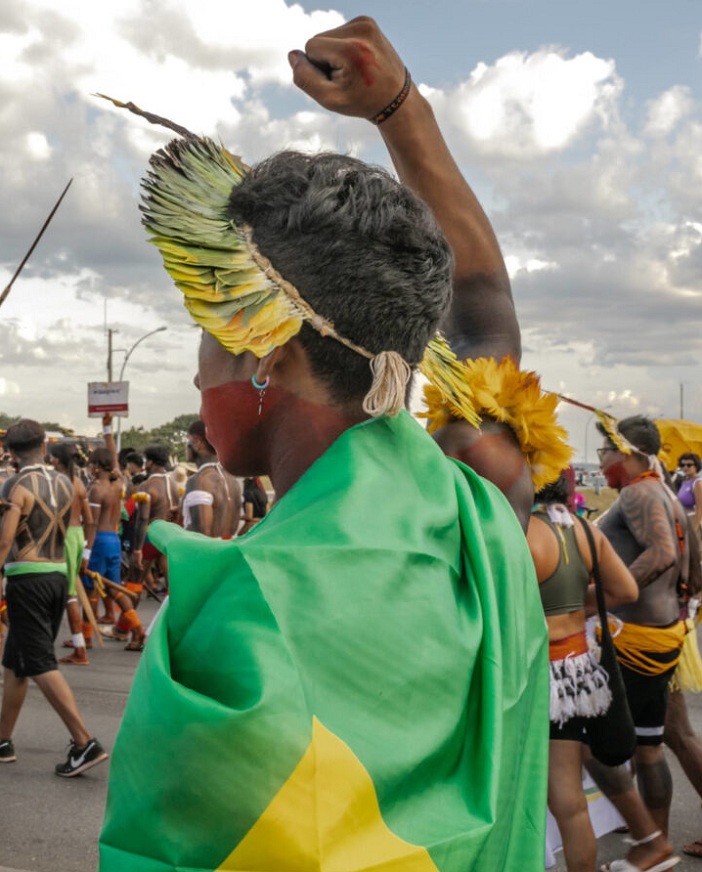
BRASILIA (Brazil): Thousands of Indigenous people from across Brazil have gathered in the capital, Brasília, to protest what they describe as ongoing violations of their land rights and growing pressure from agribusiness, mining and infrastructure projects in the Amazon region.
The demonstrations are part of the annual Free Land Encampment, the country’s largest Indigenous mobilization, which brings together communities from multiple regions to demand the demarcation and protection of ancestral territories. This year’s gathering featured marches through central Brasília, with participants urging the federal government to take stronger action to secure Indigenous lands and curb illegal or contested economic activities inside protected areas.
Protesters said their territories continue to face encroachment linked to farming expansion, logging and mining operations. They also directed criticism at national policy debates that Indigenous leaders say could weaken constitutional protections for traditional lands. While the Brazilian government has periodically supported Indigenous rights initiatives, activists argue that progress on formal land recognition and enforcement remains slow and inconsistent.
The encampment comes amid a broader pattern of recurring Indigenous mobilizations in Brazil, which have taken place for more than two decades. The Free Land Encampment has become a key platform for Indigenous groups to press for land demarcation, environmental protection and recognition of territorial sovereignty. It also serves as a space to highlight conflicts in the Amazon, where land disputes have intensified alongside development pressures and environmental degradation.
Indigenous organizations say that legally securing land rights is central to protecting both their communities and the Amazon rainforest itself. The region is considered critical for global climate regulation, but has long faced deforestation driven by agriculture expansion, cattle ranching and illegal extraction of natural resources. Indigenous leaders argue that stronger territorial protections are essential to preventing further environmental damage.
In recent years, there has been tension between Indigenous communities and government authorities over infrastructure and resource projects in the Amazon. Protesters have repeatedly called for greater consultation and consent before approvals are granted for developments that affect Indigenous territories. Legal and political disputes over land classification and usage rights have further complicated enforcement efforts.
Despite differences with the government on specific policies, Indigenous representatives continue to engage in dialogue with federal authorities while maintaining pressure through public demonstrations. Leaders say the annual mobilization remains necessary to keep Indigenous rights and environmental concerns visible in national decision-making.
The latest protest underscores ongoing disputes over land governance in Brazil, where Indigenous communities remain at the center of debates over development, conservation and constitutional protections in the Amazon region.
Click here to follow our WhatsApp channel and get instant updates