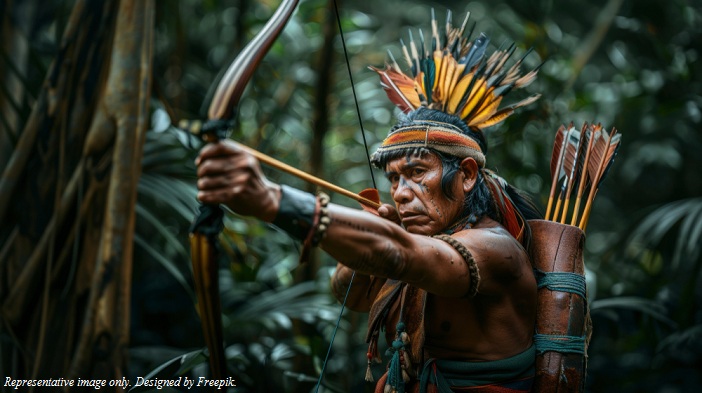
BOGOTA (Colombia): Indigenous communities in Colombia’s Amazon are intensifying efforts to protect their ancestral territories from deforestation, illegal mining, coca cultivation, armed groups and other illicit activities, naming and training hundreds of unarmed Indigenous guardians to patrol vast rainforest areas and monitor environmental threats. These community-led forces combine traditional ecological knowledge with modern tools such as GPS tracking and satellite imagery to document incursions and provide evidence to authorities, but they operate with minimal formal support and are often under threat.
The Indigenous guard system, rooted in centuries-old governance practices, has become more structured over the past two decades with councils drawing members from multiple Indigenous groups across departments including Amazonas, Putumayo and Guainía. Colombia’s constitution recognizes Indigenous self-governance and communal land rights, and recent legal advances have expanded formal administrative authority in parts of the Amazon, yet practical implementation and resource allocation remain limited. Many communities call for a public policy that funds and institutionalizes the work of guardians, who currently often serve without pay.
Defending territory for Indigenous peoples means protecting forests that are both cultural homelands and vital global carbon stores. Forest cover within Indigenous territories in the Colombian Amazon is significantly higher and more stable than in non-Indigenous lands, underscoring the effectiveness of community stewardship in conserving biodiversity and slowing deforestation. Guardians undertake activities from mapping sacred sites and waterways to reforestation efforts, managing seed banks and monitoring fish and wildlife populations, integrating ancestral knowledge with scientific methods.
However, guarding the rainforest has become increasingly dangerous. Between 2014 and 2024, at least 70 Indigenous guardians were killed in conflicts with armed groups including dissident Revolutionary Armed Forces of Colombia (FARC) factions, the National Liberation Army, paramilitary networks and criminal gangs, as well as in violent confrontations tied to extractive interests. Such violence is part of a broader national trend in which Colombia is one of the deadliest countries for environmental defenders, with dozens killed annually while opposing illegal activities that drive environmental degradation.
Beyond violent threats, guardians face structural obstacles including lack of basic equipment, communication tools and reliable transportation. In remote Amazon locations, limited state presence means that Indigenous patrols are among the few actors actively monitoring incursions, while national park officials have been unable to access many protected areas due to security risks. Defenders are also exposed to stigmatization and accusations that undermine their legitimacy and jeopardize community safety.
Despite these challenges, Indigenous guardians continue to organize collectively. Community assemblies and regional gatherings have drawn representatives from dozens of communities to share strategies, train new members and coordinate responses to escalating pressures on their lands. The guardians’ role extends to humanitarian functions such as preventing forced recruitment of minors, aiding in searches for missing people and clearing antipersonnel mines, activities that reinforce community resilience but highlight the absence of formal protection frameworks.
Government pledges in Colombia’s National Development Plan to support Indigenous guardians with financial and human resources have yielded some agreements, but many Indigenous leaders say the commitments fall short and remain largely on paper. Advocates argue that stable funding and official recognition are essential to sustain long-term conservation efforts, allowing guardians to maintain cultural practices, protect natural resources and secure the survival of their communities.
For Indigenous groups in the Amazon, territory is inseparable from identity, health and future viability. Guardians stress that losing access to forests would mean the breakdown of cultural continuity, traditional food systems and ecological balance. Their work, though perilous and under-resourced, is central to defending one of the most biodiverse regions on the planet and to upholding Indigenous rights in the face of mounting external threats.
Click here to follow our WhatsApp channel and get instant updates