
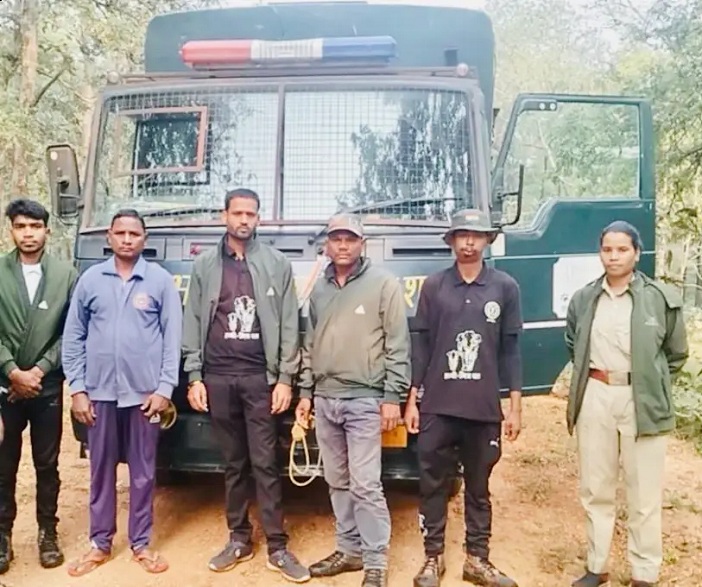
RAIPUR (Chhatisgarh, India): A tribal woman forest guard in the Indian state of Chhattisgarh is leading efforts to reduce human-elephant conflict inside the Barnawapara Wildlife Sanctuary, where increasing elephant movement has created challenges for both forest officials and local communities dependent on agriculture and forest produce.
Kamaleshwari Painkra, a forest guard posted in the Kothari range of the sanctuary, heads a 10-member Hathi Mitra Dal (Friends of Elephants Group), which is tasked with monitoring elephant movement, preventing crop damage and ensuring the safety of villagers. Her team patrols forest routes every day and responds to reports of elephant activity across the region.
Barnawapara Wildlife Sanctuary, spread over about 245 square kilometers in central Chhattisgarh, was established in 1976. The sanctuary has several villages within its boundaries, many of them dominated by tribal communities. Forest officials say elephants began staying in the area around 2019-20 after moving from neighboring regions in search of suitable habitat.
Painkra joined the forest department in 2017 and was posted to Barnawapara in 2019 after undergoing six months of training in Mahasamund district. She now supervises local volunteers selected from nearby villages to track elephant movement and alert residents in vulnerable areas.
According to forest officials, around 30 elephants currently move through Barnawapara and adjoining regions. Teams often identify their presence through footprints, dung and feeding signs, particularly on bamboo shoots and leaves, which are among the preferred food sources of the jumbos.
Human-elephant conflict remains a major concern in several eastern and central Indian states, including Chhattisgarh, Odisha, Jharkhand and West Bengal. Shrinking forests due to developmental and mining activities have contributed to rising encounters between humans and elephants.
The conflict intensifies during the mahua flower collection season in summer. Tribal communities and forest dwellers enter forests to gather mahua flowers and other minor forest produce, increasing the possibility of encounters with elephants attracted by the strong smell and sweetness of the flowers.
Forest patrol teams in Barnawapara use mobile applications such as Gaj Sanket and ODK Collect to record elephant locations and movement patterns. Officials say the digital tools help improve response coordination and tracking. However, patrolling becomes difficult during the monsoon when vehicles cannot access several forest routes, forcing teams to travel on motorcycles or scooters through elephant corridors.
Painkra recalled a close encounter earlier this year when she and another forest staff member came face-to-face with a solitary male elephant while travelling on a scooter inside the forest. They managed to retreat safely without provoking the animal.
Officials say awareness programs are also being conducted in villages to reduce panic and discourage risky practices such as using firecrackers to chase elephants away. In addition to elephant monitoring, forest authorities have launched youth volunteer initiatives and campaigns to reduce forest fires during summer months.
Click here to follow our WhatsApp channel and get instant updates