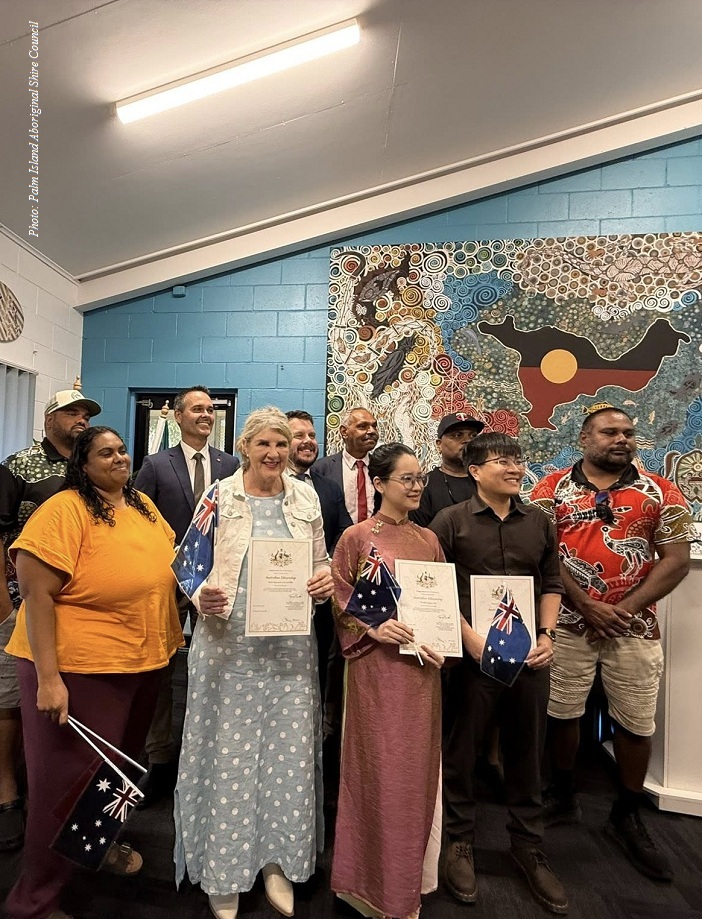
PALM ISLAND (Queensland, Australia): In a milestone moment for Australia’s Indigenous communities, Palm Island recently became the site of the country’s first citizenship ceremony to be held on First Nations land when three individuals were granted Australian citizenship.
The three individuals granted citizenship were Alison Gallagher, Thien An Le and Thi Hong Quyen Ho.
Gallagher is a nurse unit manager from New Zealand. She has served the Palm Island community for nearly seven years. Le and Ho are both originally from Vietnam. They have worked for local council’s finance department for over a decade. Each expressed deep emotional connections to the island and its residents, describing the ceremony as a moment of personal and communal significance.
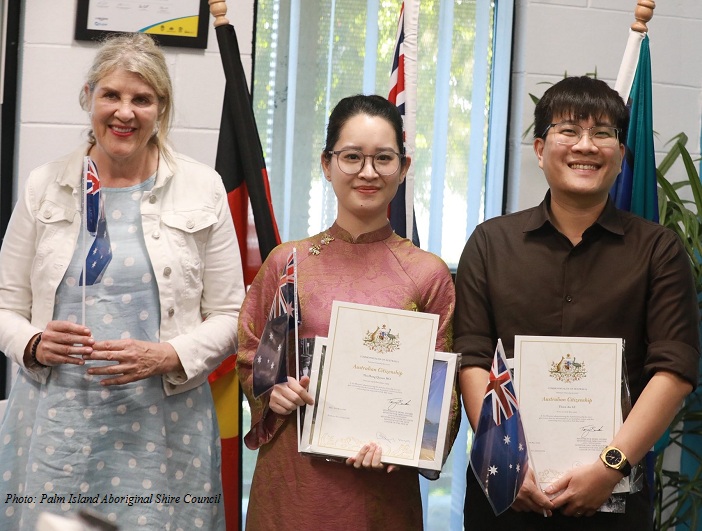
Palm Island Aboriginal Shire Council Mayor, Alf Lacey, hailed the event as “historic,” emphasizing its broader resonance for Indigenous Australians. “This ceremony is more than just an administrative formality,” Lacey said. “It reflects a recognition of the central role of the First Nations communities in Australia’s identity and demonstrates a pathway towards shared belonging and unity,” he said. Local and federal political representatives, including Herbert MP Phillip Thompson and Townsville MP Adam Baillie, were among those present.
The ceremony featured traditional cultural elements alongside formal citizenship proceedings, reflecting a blending of heritage and contemporary civic values. Observers noted the significance of holding the event on Palm Island itself, rather than in a conventional government venue, as a statement of respect for First Nations sovereignty and visibility.
The ceremony marked a first for Queensland’s Indigenous Councils as one of the world’s oldest living cultures welcomed three new Australian citizens on Manbarra and Bwgcolman Country. This could become a potential model for future efforts to integrate Indigenous communities into national life while respecting and celebrating cultural heritage.
Palm Island, off the coast of Queensland, was historically an Aboriginal settlement established under the colonial-era Queensland government’s control system for Indigenous affairs. From the early 20th century, Aboriginal people from across the state were forcibly relocated there as part of policies designed to segregate Indigenous populations from settler society, restrict their movement, and place them under close administrative oversight. The system also reflected broader state policies of assimilation and cultural suppression, which aimed to dismantle traditional languages, kinship systems, and cultural practices by concentrating diverse Indigenous groups in one controlled environment. Life on the island was heavily regulated, and residents were often subjected to coerced or directed labor under government authority, reinforcing its role as both a disciplinary and economic instrument of colonial governance.
Against this backdrop, Palm Island carries enduring historical weight in Australia’s colonial legacy. Its transformation into a place capable of hosting a citizenship ceremony led by the local Indigenous community is, therefore, highly symbolic: a site once defined by exclusion, control and forced displacement now serves as a setting for formal national inclusion and civic recognition.
Click here to follow our WhatsApp channel and get instant updates