
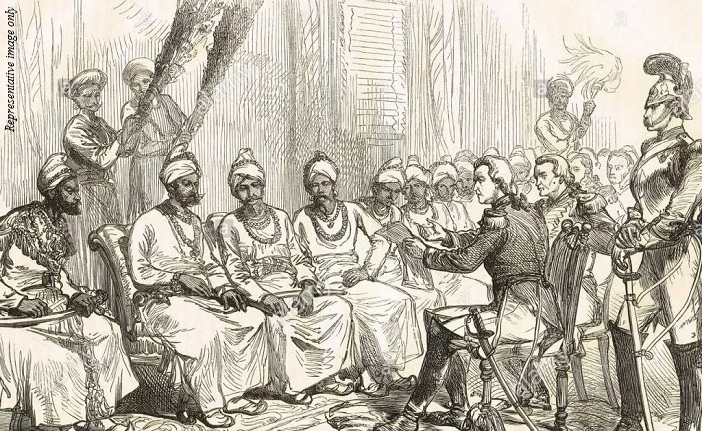
GUWAHATI (Assam, India): Indigenous and social organizations across Assam observed a “Black Day” on Tuesday to mark the 200th anniversary of the Treaty of Yandabo, an agreement that ended the First Anglo-Burmese War and led to the transfer of Assam from Burmese control to the British East India Company.
The Yandabo Treaty was signed on 24 February 1826. Multiple events were held at different locations, including Dibrugarh and Nagaon. Participants described the treaty as a decisive turning point that ushered in colonial rule and profoundly altered the region’s political, cultural and socio-economic fabric.
In Dibrugarh, a day-long program was held at the Tai Educational and Cultural Centre in Boiragimoth. Representatives from several indigenous organizations participated, including the Khilonjia Mancha, Indigenous Peoples of Mong-Dun-Chun-Kham Assam, All Assam Ahom Sabha, All Assam Matak Sanmilan, Assam Moran Sabha, All Assam Chutia Jati Sanmilan, All Assam Koch Rajbongshi Sanmilan and the North-East Indigenous People’s Forum. The Participants wore black badges as a symbol of protest and mourning.
The program began with the hoisting of flags, followed by the lighting of traditional earthen lamps and incense sticks before portraits of historical figures and freedom fighters such as King Badosa, Sukapha, Sati Sadhani, Bir Chilarai, Lachit Borphukan, Romakanta Saikia, Sarbananda Singha, Gomdhar Konwar, Maniram Dewan, Kushal Konwar, Kanaklata Barua and Raghav Moran. Speakers stressed that these icons embodied the spirit of resistance against external domination and the enduring struggle to protect indigenous culture and rights.
Two panel discussions were also held. One traced the historical context and far-reaching consequences of the Yandabo Treaty, while the other focused on defining the identity and future of Assam’s indigenous peoples, locally termed Khilonjia, and planning measures to safeguard their entitlements and cultural heritage in contemporary times.
In Nagaon, an event was organized by the Sangrami Satirtha Assam Movement. Speakers at the event described the treaty as a “watershed moment” in Assam’s history, warning that its legacy of imposed governance and cultural disruption continues to resonate in present-day debates over land rights and community autonomy.
Speakers at the two events urged younger generations to critically engage with history, not merely as a catalogue of grievances but as a foundation for constructive advocacy and unity. The programs concluded with appeals to recognize the contributions of those who resisted colonial encroachment and to work collectively towards preserving Assam’s diverse indigenous identity for the future.
The signing of the Yandabo Treaty marked the beginning of British domination in Assam, effectively ending the sovereignty of indigenous kingdoms such as the Ahom dynasty, which had ruled the Brahmaputra valley for nearly six centuries. The colonial administration introduced new land revenue systems, shifted demographic patterns through migration policies, and reoriented traditional power structures, developments that indigenous leaders at the commemoration said cumulatively eroded local rights and autonomy over generations.
Click here to follow our WhatsApp channel and get instant updates